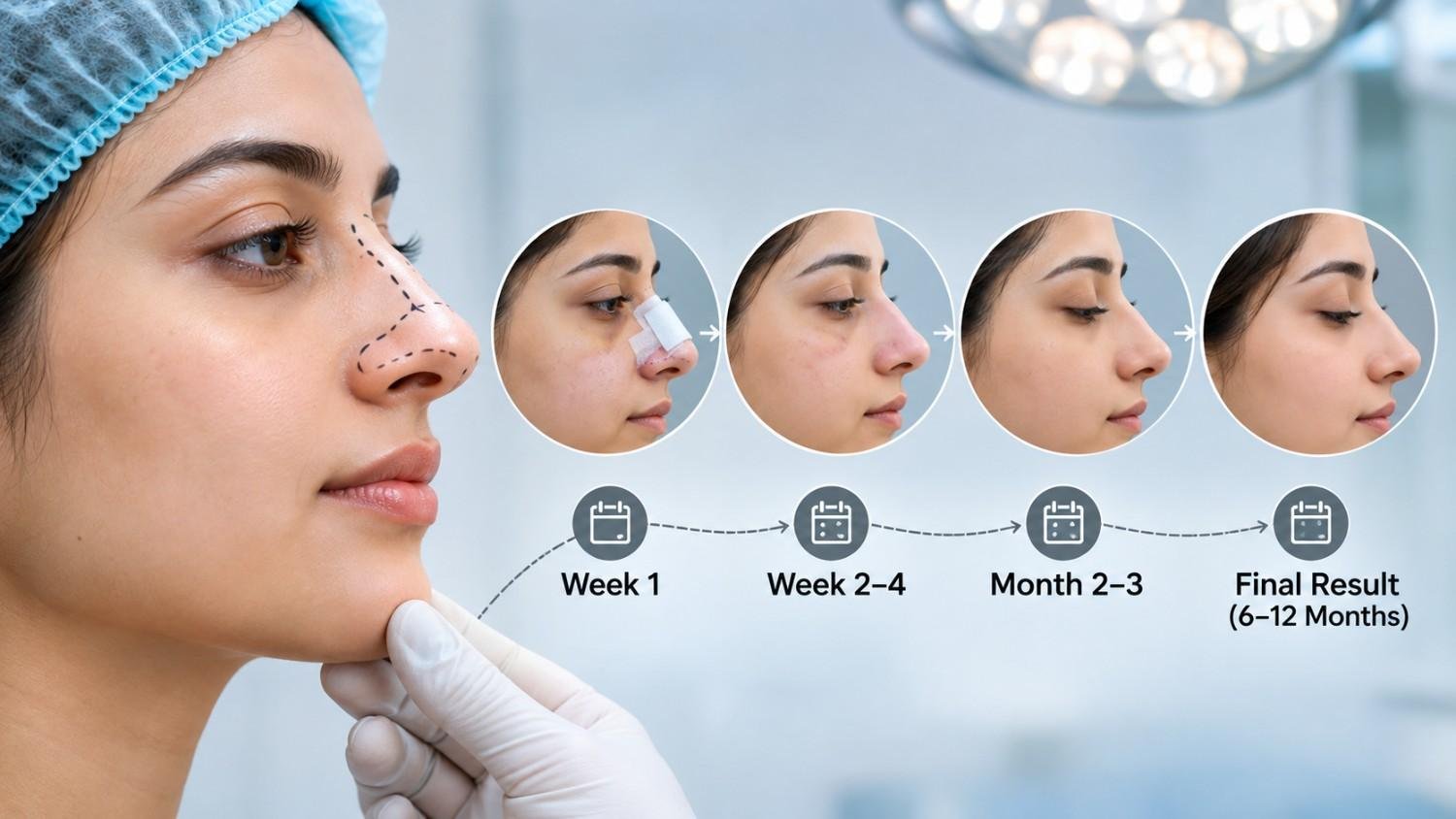
Rhinoplasty Recovery Timeline: Healing, Swelling and Expected Results
Most people return to desk work one to two weeks after rhinoplasty. The splint usually comes off after about a week, bruising fades over two to three weeks, and most swelling settles over the following months. The nose can keep refining for up to a year, with the tip often the last part to settle. How quickly you heal depends on the extent of surgery, your skin and how closely you follow your surgeon’s advice.
This guide walks through each stage, explains why swelling lasts so long, and describes what results to expect. It is general information. Your own surgeon’s instructions always come first.
Rhinoplasty Recovery Timeline at a Glance
| Stage | What is typical | What you can usually do |
|---|---|---|
| Days 1 to 3 | Swelling, blocked nose, bruising around the eyes; splint in place | Rest with head raised; take prescribed medicines |
| Days 4 to 7 | Swelling and bruising at their peak, then easing; splint usually comes off around one week | Short walks; follow-up visit |
| Weeks 2 to 3 | Bruising fades; nose still swollen | Many people return to desk work |
| Weeks 4 to 6 | First look at the shape; tip still swollen | Gradual return to exercise with clearance |
| Months 3 to 6 | Most swelling has settled; tip and bridge keep refining | Normal activities; sun protection |
| Months 6 to 12 and beyond | Subtle swelling resolves; final shape emerges | Review with your surgeon |
These are typical patterns, not promises. Healing is faster for some people and slower for others, and surgery on the bone or septum usually takes longer than work on the tip alone.
The First Week After Rhinoplasty
The first few days are the most uncomfortable, although most people describe pressure and blockage rather than severe pain. The nose feels full and swollen, and breathing through it is difficult because of swelling and any internal supports. Bruising and swelling around the eyes and face are expected in the first several days.
Rest with your head raised, including at night, to help swelling drain.
Expect to breathe through your mouth for a while. Do not blow your nose until your surgeon says it is safe.
Take prescribed medicines as directed, and ask before using any others.
Keep the splint dry and untouched. An external splint is commonly kept for around a week, then removed at a follow-up visit where healing is checked.
Short, gentle walks are usually fine. Bending, lifting and straining are not.
When the splint comes off, the nose will still look swollen and the tip may look rounded or upturned. This is normal and is not your final result.
Weeks 2 to 3: Bruising Fades, Routine Returns
Bruising around the eyes usually fades over one to two weeks, and Mayo Clinic notes that swelling or discolouration of the eyelids can last two to three weeks. (Mayo Clinic Care Network)
Many people with desk-based work go back after roughly one to two weeks, depending on their job and how visible any bruising still is. Makeup can help cover residual bruising once your surgeon agrees.
Avoid anything that could knock the nose. Contact sports, swimming and strenuous exercise are usually paused for several weeks, and your surgeon will tell you when glasses can be worn normally. If bones were reshaped, one health system advises protecting the nose from injury for about three months. (CommonSpirit Health)
Weeks 4 to 6: A First Look at the Shape
By about a month, most of the obvious swelling and bruising has gone, and the American Society of Plastic Surgeons (ASPS) says most patients see initial results around this time. (ASPS)
Your nose will still be swollen, particularly at the tip, and it may feel firm or numb in places. Exercise is usually reintroduced gradually, with your surgeon’s clearance. Be careful about judging the result at this stage.
Months 3 to 12: Gradual Refinement
After about three months, much of the swelling has usually settled, and many people feel comfortable being seen in public. Subtle swelling, however, can continue for months. Mayo Clinic notes that nasal swelling can last up to a year, and that most of it is gone within a year. Symmetrica’s rhinoplasty page makes the same point: subtle swelling, especially at the tip, can keep resolving for a year or longer.
This is why surgeons advise waiting before judging the outcome and before considering any revision. The nose also keeps changing slowly through life, with or without surgery, so “final” is a relative term.
Why Does Swelling Last So Long After Rhinoplasty?
Rhinoplasty reshapes a framework of bone and cartilage under a thin layer of skin, and the tissues involved are slow to clear fluid. The nasal tip, where skin is tight and has less drainage, holds swelling the longest. People with thicker skin often see swelling last longer, as Symmetrica’s page notes.
You cannot hurry this process completely, but you can avoid making it worse:
Follow the head-raised sleeping advice for as long as your surgeon recommends.
Reduce salt in your diet, which Mayo Clinic says helps swelling settle faster.
Avoid smoking and vaping. Mayo Clinic says they slow healing and raise the risk of infection and tissue damage.
Do not press, rub or massage the nose unless your surgeon tells you to.
Protect the nose from strong sun, as advised by your surgeon.
Attend every follow-up visit, so that problems are caught early.
What Results Can You Expect?
Rhinoplasty can change the shape, size and proportions of the nose and, in some patients, improve breathing. What it cannot do is promise a particular nose. Results depend on your anatomy, the plan agreed with your surgeon and how you heal. Some people need a small further adjustment, and risks include asymmetry, prolonged swelling, changes in sensation and breathing difficulty. Your surgeon should discuss these before you decide.
If your concern is breathing, say so at your consultation. Cosmetic changes alone may not improve airflow, so nasal function should be assessed before surgery.
What Affects How Long Your Recovery Takes?
The extent of surgery: Work on the tip alone is generally lighter than surgery involving the bones or septum.
Open or closed approach: Open rhinoplasty leaves a small scar on the strip of skin between the nostrils, which usually fades well, and may involve more swelling at the tip. Your anatomy and goals decide which approach is suitable.
Skin thickness: Thicker skin tends to hold swelling longer.
Previous nose surgery or injury: Revision surgery is generally more demanding, because scar tissue has formed.
Smoking, general health and how closely you follow instructions.
When to Call Your Surgeon
Contact the clinic promptly if you have heavy bleeding, fever, pain that is getting worse instead of better, a sudden change in the shape of your nose after a knock, or anything that worries you. Symmetrica’s rhinoplasty page gives the same advice. Do not wait for your next scheduled visit.
Frequently Asked Questions
How long does rhinoplasty recovery take?
Initial recovery takes around one to two weeks, including splint removal and fading of most bruising. Swelling continues to settle for months, and the final shape can take up to a year or longer.
When is the splint removed after rhinoplasty?
Usually after about one week, at a follow-up visit. Your surgeon decides the exact timing.
How long does swelling last after rhinoplasty?
Most visible swelling settles over the first few weeks and months. Subtle swelling, especially around the tip and in thicker skin, can last a year or longer.
When can I see my final rhinoplasty results?
You will see a good idea of the shape within a few months, but the final result can take up to a year or more to develop. Judging earlier often causes unnecessary worry.
When can I go back to work and exercise?
Many people with desk jobs return after one to two weeks. Exercise is reintroduced gradually, and contact sports are usually delayed longer. Your surgeon will give you dates for your own case.
Is rhinoplasty recovery painful?
Most people feel pressure, blockage, tenderness and soreness rather than severe pain, and this is usually managed with prescribed medicines. Pain that worsens should be reported.
Next Step: Plan Your Rhinoplasty With a Surgeon
A smooth recovery begins with careful assessment, a clear plan and realistic expectations. At Symmetrica, rhinoplasty consultations are led by plastic surgeon Dr. Amit Kr. Choudhary (MBBS, MS, MCh Plastic Surgery), and a consultation is a conversation and an examination, not a commitment to surgery.
Book a rhinoplasty consultation at Symmetrica, or call or WhatsApp +91 93398 30705.
Learn more about rhinoplasty in Siliguri, including approaches, risks and what a consultation involves.
Address: Diamond Plaza, beside Sagar Family Restaurant, 2.5 Mile, near Check Post, Sevoke Road, Siliguri 734001.