
About Us
Contrary to popular belief, Lorem Ipsum is not simply random text. It has roots in a piece of classical Latin literature from 45 BC, making it over 2000 years old.
Contrary to popular belief, Lorem Ipsum is not simply random text. It has roots in a piece of classical Latin literature from 45 BC, making it over 2000 years old.
Gynecomastia (also spelled gynaecomastia) is the enlargement of breast tissue in men or boys. It may involve glandular tissue, excess fat, or both, and it can affect one or both sides. Surgery, sometimes called male breast reduction, may be considered when the enlargement persists and bothers the person. Whether it is suitable is decided after examination and a review of possible causes.
Every man has a small amount of breast tissue. In gynecomastia, the glandular part of that tissue grows, often as a firm disc beneath the nipple, giving the chest a fuller or rounded contour. It may be slightly tender at first. It can affect one side more than the other, or both equally.
It is not a sign of weakness, and it is far more common than most men realise. It is usually benign. It is not the same as weight gain across the chest, which is why examination matters before any plan is made.
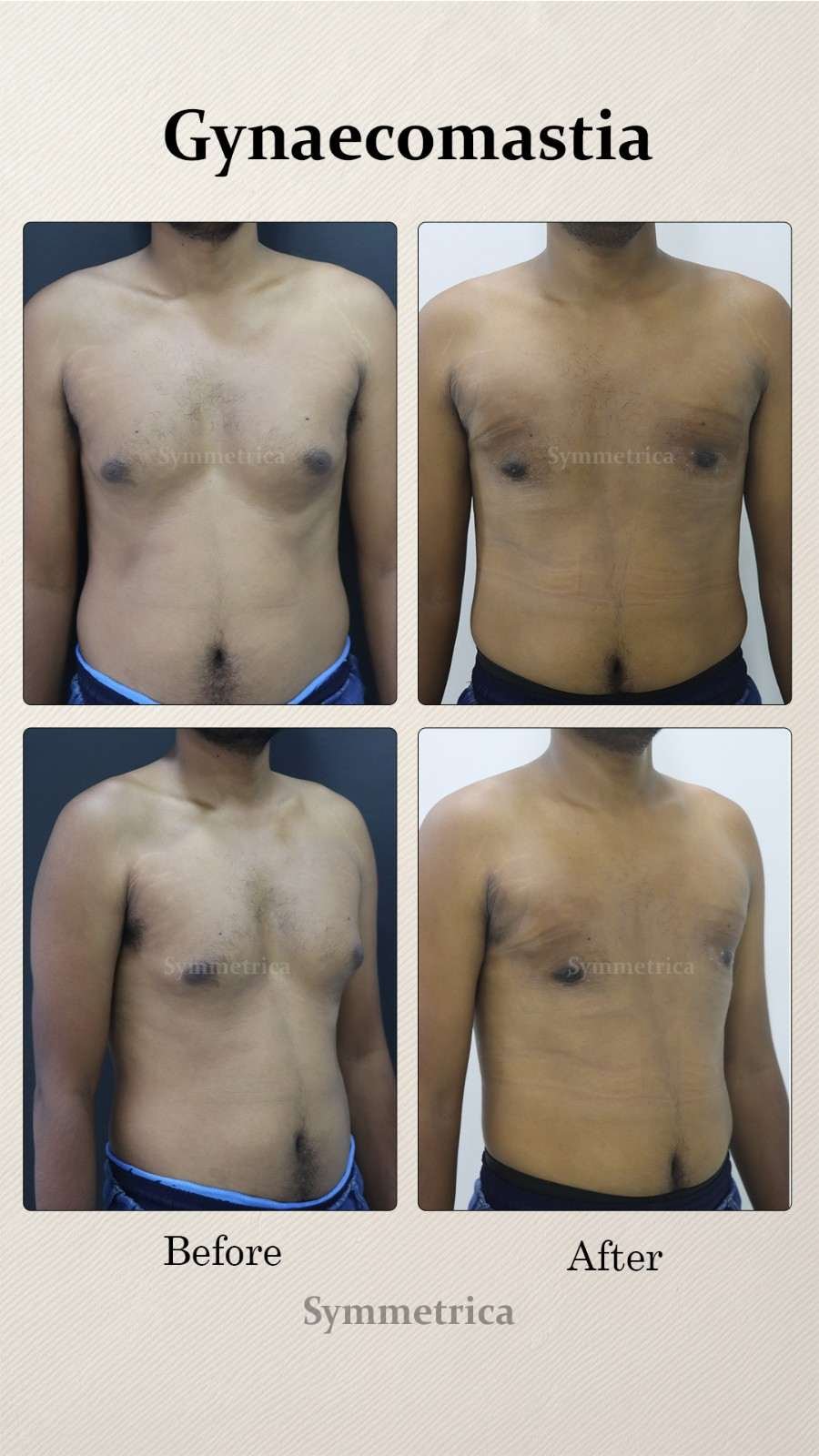
Gynecomastia can have different causes and can involve glandular breast tissue, excess fat, or both. Understanding the underlying cause helps determine whether treatment or surgery may be suitable.
Gynecomastia usually develops because of a change in the balance between oestrogen and testosterone, or because breast tissue responds differently to these hormones.
Other contributors include: Some medicines, anabolic steroids or supplements, being overweight, certain liver, kidney or thyroid conditions, low testosterone, alcohol and some recreational substances.
In many men, no clear cause is found. This does not make the enlargement less real or mean that treatment options are unavailable.
In teenagers, gynecomastia often settles by itself over a year or two, so surgery is usually not the first step.
In adults, surgery may be considered when the enlargement has persisted, the underlying cause has been assessed and managed, and the person is troubled by the appearance or tenderness.
Persistent tissue, particularly firm glandular tissue, is unlikely to disappear with exercise or weight loss alone. Whether surgery is advisable is decided after individual assessment.
The chest can appear enlarged for different reasons, and distinguishing between them helps determine the appropriate treatment approach.
Glandular tissue: Usually feels firm or rubbery and is often centred behind the nipple.
Excess fat: Usually feels softer and is distributed more evenly across the chest. Some men have a combination of glandular tissue and fat, while others have only excess fat, sometimes called pseudogynecomastia.
Examination, and occasionally imaging, can help distinguish between them and guide the treatment plan.
The right approach depends on the cause, the type of tissue involved and your individual circumstances. A consultation can help clarify the options.
Understanding your treatment journey starts with a comprehensive consultation to evaluate your specific concerns, followed by a personalized surgical plan tailored to your anatomical needs.
Your initial consultation is a thorough process focused on understanding your individual goals, reviewing your health background, and establishing the safest, most effective path forward.
You describe when you first noticed changes, whether the condition is stable or evolving, and how it impacts your daily life and personal comfort.
A complete review of your medicines, supplements, steroid use, weight history, alcohol intake, family history, and general overall health is conducted.
The surgeon examines the chest tissue to identify specific physical characteristics and determines if further investigations, such as blood tests or imaging, are required.
If an underlying hormonal or medical cause is suspected, you may be advised to consult a physician or endocrinologist before proceeding with cosmetic options.
All suitable approaches—including observation, lifestyle adjustments, or surgery—are discussed in detail, along with their benefits, limitations, and potential risks.
If surgery is determined to be the right choice, a tailored surgical plan is outlined. You are given full time to consider your options without pressure.
Treatment techniques follow the nature of the underlying tissue. Often referred to as male breast reduction or male chest contouring, the procedure is customized to deliver a natural appearance.
Removes excess fatty tissue through small, discreet incisions. This technique is ideal for chests where soft fatty tissue is the primary component.
Direct removal of firm glandular tissue through a small incision along the edge of the areola, placing the resulting scar neatly along a natural color boundary.
Many individuals benefit from a combination of liposuction to sculpt and blend the surrounding chest area, alongside targeted excision of dense glandular tissue.
In cases involving significant tissue volume or laxity, excess skin may remain after internal removal. More extensive procedures and scar considerations are discussed when necessary.
Every chest contouring treatment plan is individualized to match your body composition, health status, and aesthetic expectations.
Male chest contouring surgery is carefully planned to match your unique anatomical structure, ensuring a flatter and more defined outcome under professional surgical care.
The surgeon carefully marks the target areas on your chest while you are standing up, as this posture reveals the natural distribution and contour of the tissue.
Under appropriate anaesthesia in a sterile facility, the targeted fat and firm glandular tissue are precise removed according to your treatment plan.
Incisions are closed with fine sutures to minimize scarring, and a specialized compression garment is fitted to support the newly contoured chest during early healing.
Book a consultation at Symmetrica in Siliguri to evaluate your suitability, review the surgical process, and receive customized medical guidance.
Recovery differs based on the extent of surgery and individual healing. Follow your surgeon's directions closely for the best results.
Swelling, bruising, and a feeling of tightness are normal during the first few days. Mild discomfort is effectively managed using prescribed post-operative medications.
A supportive compression garment is typically worn for several weeks as directed by your surgeon to control swelling and support tissue adaptation.
Scheduled follow-up visits allow the surgeon to monitor progress, inspect dressings, check stitches, and ensure proper healing of the surgical sites.
Most patients return to desk work within roughly one week. Strenuous exercise, heavy lifting, and intense physical activity should be avoided for several weeks.
Swelling gradually subsides over weeks to months, allowing the refined chest contour to emerge over time as tissues fully settle.
Every surgical incision leaves a scar. Liposuction marks are small and fade over time. Areola edge incisions sit on a natural color boundary to blend in, though scarring depends on individual healing. Cases requiring skin removal leave longer scars.
Potential surgical risks include bleeding (haematoma), fluid collection (seroma), infection, contour irregularities, nipple sensation changes, visible scarring, or possible tissue recurrence if weight or underlying causes change.
Surgical suitability depends on a complete clinical evaluation. Surgery may be delayed or inappropriate if you have:
Surgery aims to create a flatter, more even chest shape, but individual outcomes vary and final contours take months to settle. Results last best when weight and overall health remain stable. Mutual agreement on realistic goals during consultation is essential.
Discreet, one-to-one individual consultations in a comfortable clinic setting.
Comprehensive clinical evaluations addressing underlying causes alongside aesthetics.
Formal qualification in plastic and reconstructive surgery techniques.
Guidance toward medical review or observation whenever surgery is unnecessary.
Continuous monitoring throughout your entire post-operative recovery.
Based in Siliguri, providing quality specialized care close to home in North Bengal.
It is the enlargement of male breast tissue involving firm glandular tissue, excess fatty tissue, or a combination of both, occurring on one or both sides of the chest.
Common causes include hormonal imbalances, prescription medications, anabolic steroid use, weight changes, or underlying health conditions. In many men, no specific cause is identified.
In adolescents, tissue enlargement often resolves naturally within 1 to 2 years. In adults, long-standing glandular tissue rarely subsides without medical or surgical intervention.
Male breast reduction (chest contouring) is a procedure designed to remove excess glandular tissue, fat, and loose skin to produce a flatter, firmer chest profile.
Liposuction targets and removes excess fatty deposits, while gland excision surgical removes firm, dense glandular tissue. Many men require a combination of both for an optimal result.
Suitable candidates include men in good general health with stable body weight, realistic goals, and managed underlying medical factors, as confirmed during a clinical evaluation.
Most patients return to non-strenuous desk work within about one week. Heavy lifting and physical exercise are typically paused for several weeks while swelling resolves over months.
Yes, all surgical procedures leave scars. Incisions for liposuction and areolar gland removal are small and placed discreetly along natural borders to fade well over time.