About Us
Contrary to popular belief, Lorem Ipsum is not simply random text. It has roots in a piece of classical Latin literature from 45 BC, making it over 2000 years old.
Contrary to popular belief, Lorem Ipsum is not simply random text. It has roots in a piece of classical Latin literature from 45 BC, making it over 2000 years old.
Head and face plastic surgery is the branch of plastic surgery that reshapes, restores or rejuvenates the features of the head and face. It includes cosmetic operations on the nose, eyelids, cheeks, chin and lips, procedures for facial ageing, and reconstructive work after injury or scarring. Which procedure fits, if any, depends on your anatomy, health and goals, and is decided at a consultation.
It helps to think of the face as a set of connected parts rather than a list of features. The nose changes how the chin reads, the eyelids interact with the brow and cheek, and ageing rarely affects just one layer. Facial plastic surgery covers procedures on any of these structures, from the nose and eyelids to the jawline, cheeks, lips and ears.
The work divides loosely into two kinds. Facial cosmetic surgery aims to change appearance: refining a profile, say, or softening the effects of ageing. Reconstructive facial surgery aims to restore form and function after injury, scarring or a structural problem. The two overlap. A nose repaired after a fracture may also be reshaped, for example. Symmetrica’s wider cosmetic surgery services sit alongside this.
Every face differs in bone structure, skin quality, fat distribution and symmetry, so the same procedure can suit one person and not another. Choosing from a photograph or an article is rarely reliable. That decision belongs in a consultation, after examination.
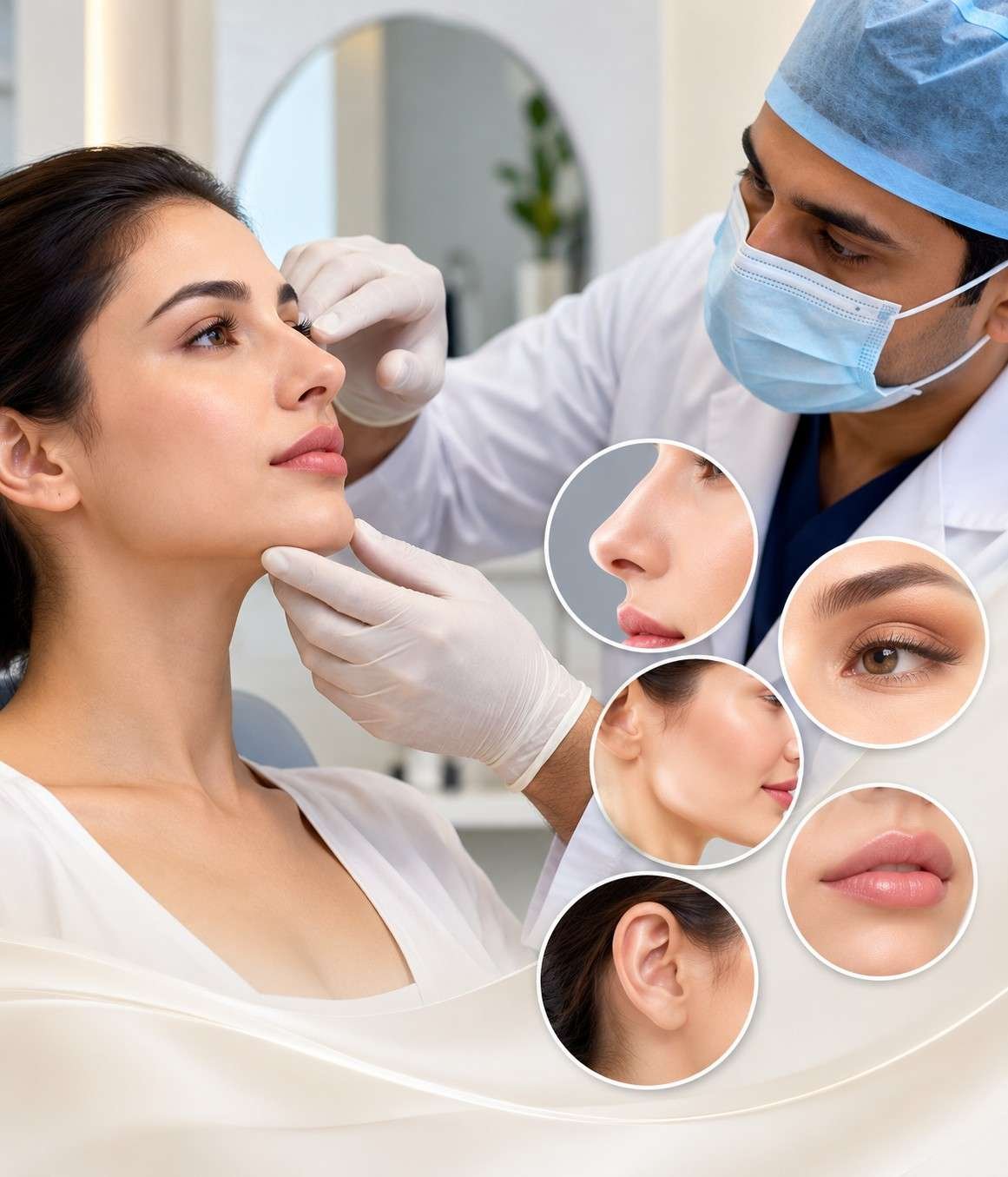
Most people don’t start with a procedure name. They start with something they notice in the mirror. Below is a guide to help point you in the right direction. It is for informational purposes and is not a diagnosis.
Reshaping the bridge, tip or nostrils, sometimes to help breathing as well.
Lifting loose lower-face and neck tissue to restore natural structure.
Heavy upper lids, puffiness below the eyes, or a lid crease that is absent or faint.
Adding or reducing volume to refine overall facial shape and definition.
Adding projection to a recessed chin to improve facial symmetry.
Adjusting lip fullness, contour, or proportion for a natural enhancement.
Reducing lower-cheek volume in selected faces to accentuate cheekbones.
Repairing or reconstructing torn, stretched earlobes, and other ear structure problems.
Improving visible facial scars and keloids where suitable after trauma or surgery.
Ten procedures make up the head and face range. Each is introduced briefly here; the dedicated pages go deeper into techniques, suitability, and care.
Reshapes the nose to change its size, profile or proportions and, in some patients, to improve airflow. It may be considered for a prominent bridge, a broad tip or asymmetry after injury.
Addresses age-related laxity in the lower face and neck, such as jowls and loose skin, by repositioning deeper tissue and removing excess skin.
Removes or repositions excess skin and fat of the upper or lower lids, and includes Asian eyelid surgery to form an upper-lid crease.
A broad term for procedures that adjust the shape or fullness of the face, depending on whether the concern arises from fat, bone, muscle or skin.
Adds projection to a recessed chin, usually with an implant, to balance the chin with the nose and lips across the full profile.
Removes part of the fat pad in the lower cheek to reduce fullness. Suitability depends closely on natural face shape and age.
Creates cheek dimples by forming a small, controlled attachment between the skin and underlying facial muscle.
Alters lip volume or proportion: augmentation adds fullness, while reduction removes tissue from a disproportionately large lip.
Fat taken from another part of the body is processed and placed in the face to restore volume or soften hollows in the cheeks or temples.
Repairs torn or stretched earlobes, often caused by heavy earrings or injury, alongside other structural ear concerns.
Every face is unique. Exploring options starts with understanding how different facial features interact and which procedures fit your goals.
The nose sits at the centre of the face, so even small changes shift overall balance. Surgery may be considered for shape or proportion and, where a structural problem such as a deviated septum is involved, for breathing—sometimes both together. Planning looks at nasal structure, skin thickness, and how the nose relates to the forehead and chin.
Ageing shows up in layers. In the lower face, it appears as jowls and a softer jawline; in the neck as loose skin; around the eyes as heavy upper lids or puffiness beneath. A facelift, with or without a neck lift, addresses laxity by repositioning deeper tissue and trimming excess skin, while eyelid surgery treats the lids themselves.
Contouring is about proportion. Buccal fat removal reduces lower-cheek fullness. Chin augmentation changes how the profile balances. Fat grafting adds soft volume where a face has hollowed, while dimpleplasty and lip procedures alter expressive details. Changing one variable alters how its neighbours read, so these are planned together.
Book a consultation at Symmetrica in Siliguri to have your facial features examined and your questions answered by our specialists, with no obligation to go ahead.
Not every facial concern calls for an operation, and not every operation can be replaced by a non-surgical treatment.
Symmetrica offers Botox, dermal fillers, HydraFacial, laser skin treatments, chemical peels, microneedling, radiofrequency treatment, mesotherapy, and thread lifts.
These treatments suit different concerns: Botox softens expression lines, fillers restore modest volume, and peels, microneedling, and lasers work on skin texture and tone.
Non-surgical treatments are not automatic substitutes for surgery. Significant sagging or excess skin generally cannot be corrected by injections, and many non-surgical results are temporary and require repeating.
The right choice depends on your concern, anatomy, skin and tissue condition, desired outcome, medical history, and expectations. Sometimes a combination of treatments is recommended.
A photograph of a result you admire shows what happened to someone else’s face—it cannot tell you what would suit yours. In consultation, the surgeon weighs key factors to guide your decision.
Evaluating what you want to change, and how much alteration is realistic and achievable.
Assessing underlying bone structure, cartilage, fat distribution, and facial symmetry.
Examining skin condition, elasticity, thickness, and age-related tissue changes.
Reviewing your health background, previous surgical or aesthetic procedures, and healing factors.
Considering the downtime you can realistically take and determining if surgery is suitable for you at all.
It is plastic surgery of the nose, eyes, cheeks, chin, lips, ears and ageing face. Some procedures aim at appearance, others at restoring form after injury or scarring.
The range includes rhinoplasty, facelift, eyelid surgery, buccal fat removal, chin augmentation, dimpleplasty, lip augmentation and reduction, facial fat grafting and ear reconstruction.
Surgery changes underlying structure and is more invasive, with longer recovery. Non-surgical treatments such as Botox, fillers or peels work on lines, volume or skin quality with little downtime but usually need repeating.
Suitability depends on health, facial anatomy, skin, age-related changes and realistic goals. Smoking and some medical conditions can raise risk. Only an in-person assessment can say whether surgery is appropriate.
Rhinoplasty reshapes the nose to change its size, profile or proportions, and sometimes to improve breathing. It is done through an open or closed approach, depending on the plan.
A facelift lifts and repositions deeper tissue of the lower face and removes excess skin to address sagging and jowls. It treats laxity, not every sign of ageing.
Eyelid surgery, or blepharoplasty, removes or repositions excess skin and sometimes fat from the upper or lower lids. Asian eyelid surgery creates an upper-lid crease.
Facial contouring refers to procedures that change facial shape or fullness by reducing, adding or reshaping volume. Which one fits depends on what is causing the concern.
Start with the concern, not the procedure name. A surgeon then considers your anatomy, skin, age, history and expectations, and may recommend surgery, a non-surgical option, or neither.
You can arrange a consultation at Symmetrica on Sevoke Road, Siliguri, with plastic surgeon Dr. Amit Kr. Choudhary. Use the appointment page or call +91 93398 30705.
Yes. Patients travel from other parts of North Bengal for consultation. Ask the team how to plan visits and follow-up around travel.
Book through the appointment page, call +91 93398 30705, or use the contact page. Bring previous medical records and a list of current medicines.