About Us
Contrary to popular belief, Lorem Ipsum is not simply random text. It has roots in a piece of classical Latin literature from 45 BC, making it over 2000 years old.
Contrary to popular belief, Lorem Ipsum is not simply random text. It has roots in a piece of classical Latin literature from 45 BC, making it over 2000 years old.
Quick Answer: A facelift (rhytidectomy) is a surgical procedure that lifts and repositions sagging tissue in the lower face and neck and redrapes the skin to create a more defined jawline and smoother lower-face contours. At Symmetrica in Siliguri, Dr. Amit Kr. Choudhary, a plastic surgeon, assesses candidacy, technique and expected results during an in-person consultation.
A facelift, medically called rhytidectomy, is surgery that lifts sagging tissue in the lower face and neck and redrapes the skin over a firmer foundation. People usually consider it when jowls, a softening jawline or loose neck skin begin to bother them and creams, fillers or other non-surgical treatments no longer reach the underlying laxity. Because a facelift changes deeper facial structures, the decision to proceed, and the technique used, should come from a qualified plastic surgeon after a proper examination, not from photographs of other people's results.
At Symmetrica, facelift consultations are led by Dr. Amit Kr. Choudhary (MBBS, MS, M.Ch Plastic Surgery) at the clinic on Sevoke Road, Siliguri. This page explains what a facelift can and cannot do, who may be a suitable candidate, what recovery involves and which risks to weigh, so you arrive at your consultation with better questions.
Book a facelift consultation: Speak with a specialist on +91 93398 30705, message the clinic on WhatsApp, or request an appointment online.
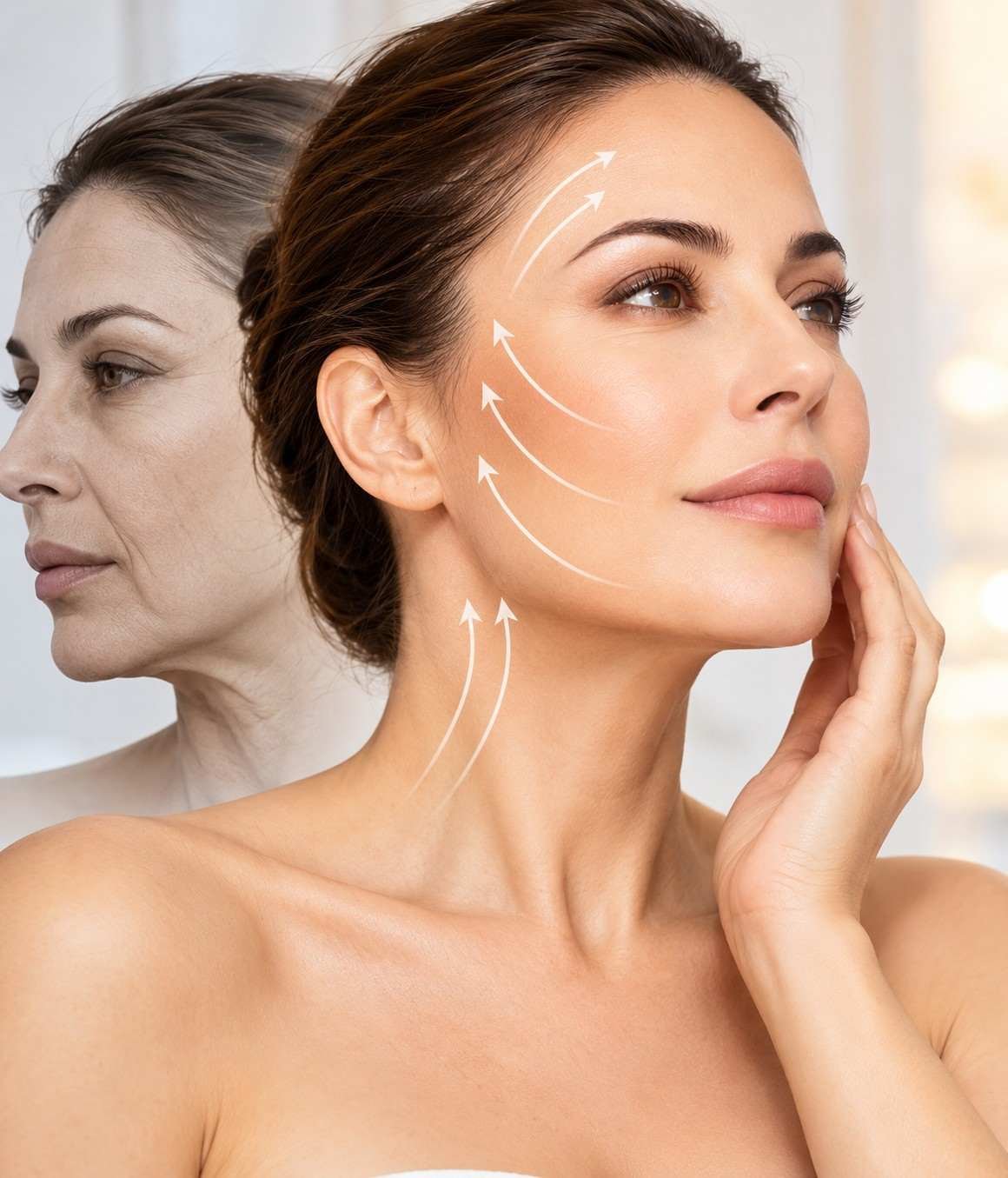
A facelift addresses visible ageing in the lower two-thirds of the face and the neck. Through incisions usually placed in and around the ear and hairline, the surgeon lifts and repositions the deeper supporting layer of the face, trims excess skin where appropriate and redrapes the rest so that tension falls on the deeper tissue rather than on the skin surface. That difference is why modern techniques generally look less "pulled" than older skin-only lifts.
A facelift mainly targets:
It does not replace skin treatments for pigmentation, fine lines or texture, does not lift the eyebrows or correct heavy upper eyelids, and cannot stop further ageing. Those concerns are handled with other procedures, which can be planned alongside a facelift when suitable.
| Technique | What it involves | Often considered when |
|---|---|---|
| Mini facelift (limited incision) | Shorter incisions, focused on the lower face and jowls. | Mild to moderate laxity and earlier changes. |
| SMAS facelift | Tightens or repositions the SMAS, the layer beneath the skin, then redrapes the skin. | Moderate laxity of the jawline and lower face. |
| Deep plane facelift | Releases and repositions deeper cheek and jowl tissue as a unit. | More advanced laxity; needs specific surgical training. |
| Neck lift (platysmaplasty) | Tightens neck muscle bands and removes excess neck skin; often combined with a facelift. | Neck bands and loose neck skin. |
Candidacy is decided at consultation, but surgeons generally look for key physical and health considerations before recommending surgery.
A facelift may not be the right first step if your main concern is volume loss, skin quality or early fine lines; non-surgical options such as anti-ageing treatments may serve you better.
If you tend to form thick or raised scars (hypertrophic or keloid), have a bleeding disorder or take blood-thinning medicines, these need a careful discussion before any decision.
Usually general anaesthesia, or deep sedation with local anaesthesia, chosen by the surgical and anaesthesia team according to the extent of surgery and your health. [VERIFY BEFORE PUBLISHING: anaesthesia approach and surgical facility used by Symmetrica]
Placed to keep scars as discreet as possible, typically in front of and behind the ear and into the hairline. Neck work may need a small incision under the chin.
The deeper layer is tightened or repositioned, and fat may be sculpted or redistributed.
Excess skin is trimmed and the remainder is laid without tension.
Fine sutures, sometimes a thin drain and a light compression dressing to limit swelling and bruising.
Surgery commonly takes several hours, depending on the technique and on whether other procedures are combined.
You are not obliged to book surgery after a consultation, and a good consultation can end with advice to choose a less invasive option.
Medicines and supplements, smoking, previous surgery, allergies, scarring tendency and any past anaesthesia problems.
Skin quality, fat distribution, jowl and neck laxity, facial symmetry, hairline and ear position.
What bothers you, and what you want to keep unchanged.
The technique recommended and why, any combined procedures, and suitable non-surgical alternatives.
Time away from work, restrictions, follow-up visits and a written estimate. [VERIFY BEFORE PUBLISHING: confirm the clinic provides written estimates]
Book a consultation at Symmetrica in Siliguri to discuss your concerns, understand your options and get answers to your questions from the surgeon before deciding on treatment.
Recovery varies with technique, the extent of surgery, age and individual healing. The ranges below are general, not a promise, and your surgeon will give you your own timeline. [VERIFY BEFORE PUBLISHING: align with Dr. Choudhary's post-operative protocol]
Swelling, bruising, tightness and numbness are common. You will be advised to keep your head raised and to take prescribed medicines.
Dressings and sutures are reviewed, and bruising fades gradually. Many people limit social plans during this period.
Swelling continues to settle, normal sensation returns slowly and scars mature. The final contour is judged after months, not weeks.
Strenuous exercise, heavy lifting and sun exposure are usually restricted for a period your surgeon will specify, and smoking should be avoided. Contact the clinic urgently for rapidly increasing swelling on one side, severe pain, fever, spreading redness or difficulty breathing.
Early contour changes become clearer once the initial swelling settles, and the final result emerges over several months. The usual aim is a natural, rested appearance rather than a visibly "operated" look.
Outcomes depend on skin quality, bone structure, genetics, sun exposure, smoking, weight changes and surgical technique. Ageing continues naturally after surgery.
Note: Photographs of other patients are illustrations of possibility, not guarantees or exact predictions of your individual outcome.
See what other patients have shared in the clinic's patient reviews and photo gallery.
[INSERT VERIFIED DATA: consented before-and-after photographs, only if clinic policy and applicable regulations permit]
| Option | What it mainly addresses | Main limitation |
|---|---|---|
| Facelift | Moderate to advanced laxity in the jawline, lower face and neck | Surgery, with anaesthesia, recovery time and surgical risks |
| Thread lift | Mild sagging | Modest and temporary compared with surgery |
| Dermal fillers | Volume loss and fold softening | Adds volume; does not remove loose skin |
| Radiofrequency treatment | Early skin laxity and firmness | Limited effect on established sagging |
| Mesotherapy and skin treatments | Skin quality, hydration and texture | Does not lift tissue |
These options are not mutually exclusive. Many treatment plans combine surgery with skin treatments once healing is complete.
A facelift is major surgery. The list below is not exhaustive, and your surgeon should go through the specific risks that apply to you during your consultation.
A facelift (rhytidectomy) is a surgical procedure that tightens and repositions tissue in the lower face and neck and redrapes the skin, usually to improve jowls, jawline definition and loose neck skin. It does not treat skin texture or pigmentation, and it does not stop ageing.
Adults in good general health who have visible laxity in the jawline, cheeks or neck, reasonably elastic skin, realistic expectations and who do not smoke are often considered suitable. Only an in-person examination by a plastic surgeon can confirm candidacy, and a less invasive option may suit early changes better.
Most people describe tightness, pressure, swelling and numbness more than sharp pain, particularly in the first week. Surgery is performed under anaesthesia, and discomfort afterwards is usually managed with prescribed medicines. Pain levels vary, and severe or worsening pain should be reported to your surgeon promptly.
Recovery varies. Bruising and swelling are usually most visible in the first one to two weeks and then fade gradually, while subtle swelling, numbness and scar maturation can continue for several months. Your surgeon will give you an individual timeline for returning to work, exercise and sun exposure.
A facelift cannot stop ageing, so the outcome depends on how your face continues to change. Many people look more refreshed for years than they otherwise would have, but the length of benefit varies with skin quality, genetics, sun exposure, smoking and weight changes.
Risks include bleeding under the skin (hematoma), infection, delayed healing, visible or raised scars, temporary or, rarely, lasting nerve injury, skin loss near incisions, hair thinning near incisions, asymmetry and anaesthesia-related complications. Smoking and some medical conditions raise certain risks. Your surgeon should discuss them with you before you decide.
There is no single price. Cost depends on the technique, whether a neck lift or other procedures are combined, anaesthesia, facility charges and follow-up care. Symmetrica provides an estimate only after an in-person consultation. [INSERT VERIFIED DATA: publish a starting price or range only if the clinic chooses to]
They address different levels of ageing. A thread lift may offer a modest, temporary lift for mild sagging, while a facelift repositions deeper tissue and is generally considered for moderate to advanced laxity. The right choice depends on your anatomy and goals, which a consultation can clarify.
There is no ideal age. Facelifts are most often considered in middle age and later, when sagging in the jawline and neck is established, but suitability depends on tissue changes and overall health rather than a number. Earlier concerns may respond to non-surgical treatments.
Yes, when it is medically appropriate. A facelift is often planned alongside a neck lift and may be combined with eyelid surgery, fat grafting or skin treatments. Combining procedures lengthens surgery and can affect recovery, so your surgeon will advise what is safe for you.
Medical Disclaimer: The content on this website is for general information only and is not a substitute for professional medical advice, diagnosis or treatment. Results vary from person to person. Consult a qualified medical professional to discuss your individual needs, possible risks and treatment options.